We created StudyinEurope.eu to support students like you — with clear information, personalized guidance, and a space to explore calmly. No rankings. No noise. Just tools that help — whether you're browsing on your own or getting help from Leonardo, our AI European Study Advisor.
Os programas de produção musical na Europa ensinam você a criar, gravar e moldar o som gravado em diversos gêneros — do pop e da música eletrônica ao áudio cinematográfico e formatos imersivos.
programas de Produção Musical na Europa de 3 universidades · atualizado para 2026
Ir para:
Pesquisar programas de Produção Musical
Leonardo
I can help you understand and compare these programs.
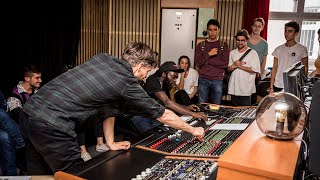
Uma semana típica envolve sessões de DAW no Ableton Live ou Logic Pro, workshops de tratamento acústico e gravação em estúdio, tutoriais de design de som, análises de mixagem e, cada vez mais, sessões sobre áudio espacial e produção em Dolby Atmos. A Europa possui uma forte tradição em música eletrônica e uma próspera indústria de estúdios em Londres, Berlim, Estocolmo e Amsterdã. Escolas especializadas como o SAE Institute, a Berklee Valencia e um número crescente de programas vinculados a conservatórios oferecem caminhos para ingressar nessa área. Vale ser honesto: a produção musical é extremamente orientada por portfólio. Empregadores e colaboradores julgam o seu trabalho, não o seu diploma. Um sólido acervo de trabalhos lançados ou encomendados terá muito mais peso do que o nome da sua instituição na maioria dos processos seletivos.
O Que Você Realmente Estuda
Áreas principais dentro de Produção Musical
Produção em DAW, arranjo e mixagem para gêneros comerciais contemporâneos
Técnicas de gravação em estúdio, posicionamento de microfones e princípios de acústica
Design de som e síntese para música eletrônica, cinema e mídia interativa
Negócios da música, licenciamento de sync e como navegar na indústria na era do streaming
Por Que a Europa para Produção Musical?
O que torna os programas europeus distintos nesta especialização
Europe's electronic music scene — from Berlin techno and UK grime to Scandinavian pop production — generates genuine professional networks and industry contexts that are distinct from American music production traditions. European music collecting societies and record labels have strong operational footprints in London, Stockholm, Amsterdam, and Berlin. The EU's Creative Europe program supports music projects and artist development initiatives. The Bologna Process enables degree recognition across 48 EHEA countries, and European cities with strong scene credentials provide the professional environment — clubs, studios, labels, sync companies — where music production careers are built.
Para Onde Leva
Caminhos de carreira para graduados em Produção Musical
Produtor Musical trabalhando com artistas em contextos de estúdio por gênero ou lançando música original de forma independente
Engenheiro de Áudio em estúdio de gravação ou casa de pós-produção, atuando com mixagem e masterização
Designer de Som para videogames, cinema ou instalações interativas, criando ambientes sonoros exclusivos
Salários e Perspectivas de Carreira
O que os graduados nesta área ganham de forma realista
€20,000 – €45,000 (audio engineering and studio roles; production income is highly variable and genre-dependent; multi-stream income combining production, mixing, and teaching is standard)Faixa Salarial Típica
Como Entrar na Área
O que programas e empregadores realmente buscam
Music production programs admit based on submitted work (tracks, mixes, or recordings) and often an interview or practical test. What matters most is evidence of ears and judgment: a produced track that demonstrates intentional creative and technical decision-making is worth more than technically clean but generic work. Programs vary substantially in emphasis — some are primarily live recording and mixing focused, others are production and composition focused, and others specialize in electronic music or scoring. Clarify the focus before applying. Building a SoundCloud or streaming portfolio before applying, and seeking feedback from working producers, is the best practical preparation. For post-production and sound design, a portfolio demonstrating work to picture is relevant.
Programas sobre Produção Musical
Programas com conteúdo sólido nesta especialização, de fontes europeias verificadas
Composition and Music Technology
Estonian Academy of Music and Theatre Tallinn, Estonia
Bachelor's English 3 years
EU: €1,600 Per yearNon-EU: €7,500
Tap to see program details
Composition and Music Technology Estonian Academy of Music and Theatre
This curriculum includes four fields: classical composition, electroacoustic composition, audiovisual composition, and recording arts. These areas support interdisciplinary creativity, offering students flexibility in mentorship and artistic direction. The program emphasizes practical experience through concerts, collaborations with national festivals, and access to high-level studios and recording facilities. Audiovisual composition bridges visual and sonic arts, while recording arts uniquely focus on classical, pop, and jazz recording. The program is globally connected, featuring international guests and culminating annually in the COMMUTE Festival.
Applicants must have completed high school or secondary education, with documents accepted in English. Original or certified copies must be presented upon arrival or sent to the Estonian Academy of Music and Theatre (EAMT). A relevant portfolio of original works is also required as part of the application. Proof of English language proficiency is mandatory. Full admission details and deadlines are available on EAMT’s official website.
Estonian Academy of Music and Theatre Tallinn, Estonia
Master's English 2 years
EU: €1,600 Per yearNon-EU: €7,500
Tap to see program details
Composition and Music Technology Estonian Academy of Music and Theatre
This master's program is structured into five main components. Students complete 30 ECTS in their chosen major, and 35 ECTS in practical courses related to their major, including additional hands-on training. Another 35 ECTS are dedicated to music theory, history, pedagogy, and general studies—covering core musical knowledge and basic entrepreneurial skills. The Master's examination accounts for 15 ECTS, and students also take 5 ECTS in freely chosen elective courses.
Applicants must hold an undergraduate diploma (or higher) and demonstrate proficiency in English. A relevant portfolio showcasing original works is required as part of the application. All qualification documents must be submitted in English.
Catalyst – Institute for Creative Arts & Technology Berlin, Germany
Bachelor's English 3 years
EU: €5,528 Per semesterNon-EU: €5,528
Tap to see program details
Electronic Music Production and Performance Catalyst – Institute for Creative Arts & Technology
This bachelor's program is designed for aspiring electronic music artists who want to develop both technical expertise and a strong artistic identity. Across three years of study, students build hands-on skills in recording, sequencing, synthesis, sampling, mixing, and mastering, while also exploring creative programming, instrument design, and live performance. The curriculum progresses from foundational practice in the first year — where students begin shaping their sound and building a portfolio — to more advanced technical and conceptual work in the second year, including custom instrument building, media-based composition, and performance systems design. The final year is centered on independent, self-directed projects that bring together artistic, technical, and critical skills developed throughout the program, with an emphasis on presenting finished work publicly and preparing for a professional career. Beyond production skills, the program places strong importance on critical thinking, artistic reflection, and understanding electronic music within its cultural and industry contexts. Students learn to articulate their creative direction, collaborate across disciplines, and develop the organizational and professional skills needed to sustain an independent practice. Notably, the first year can also be completed as a standalone Higher Education Certificate, with the option to continue into the full degree upon successful completion.
To apply, students must have completed high school at a level that would normally allow university entry in their home country. Applicants who do not hold a formal qualification but have relevant professional or life experience may also be considered through a non-standard admissions route. All applicants must submit personal and educational information, proof of prior education, a portfolio, and a personal statement or audio/video introduction. Since the program is taught in English, a minimum proficiency of IELTS 6.0 (or B2 level) is required, which can be demonstrated through a recognized language certificate or a free online test offered by the institution.
Catalyst – Institute for Creative Arts & Technology Berlin, Germany
Bachelor's English 3 years
EU: €5,528 Per semesterNon-EU: €5,528
Tap to see program details
Creative Audio Production and Sound Engineering Catalyst – Institute for Creative Arts & Technology
This bachelor's program prepares students for a professional career in music production, recording, and sound engineering through a hands-on, project-based curriculum. In the first year, students build a solid technical foundation by working with industry-standard tools, DAWs, and hardware, developing skills in recording, mixing, and production while applying concepts such as psychoacoustics and acoustics to shape their sound. The second year advances this expertise further, introducing large-scale studio work, mastering, synthesis, sampling, and emerging technologies including AI in music production, while helping students strengthen their artistic identity and critical listening abilities. The first year can also be completed as a standalone Higher Education Certificate for those who wish to begin with a shorter qualification.
By the final year, students take full creative ownership of an original project — from concept through to public release — developing the professional, leadership, and collaborative skills needed to launch a career in the contemporary music industry. Throughout the program, equal emphasis is placed on technical mastery and the development of a clear, distinctive creative voice, ensuring graduates are well-equipped to work as producers, recording engineers, or creative practitioners in today's music landscape.
To apply, students must have completed high school at a level that would normally allow university entry in their home country. Applicants who do not hold a formal qualification but have relevant professional or life experience may also be considered through a non-standard admissions route. All applicants must submit personal and educational information, proof of prior education, a portfolio, and a personal statement or audio/video introduction. Since the program is taught in English, a minimum proficiency of IELTS 6.0 (or B2 level) is required, which can be demonstrated through a recognized language certificate or a free online test offered by the institution.
Catalyst – Institute for Creative Arts & Technology Berlin, Germany
Bachelor's English 3 years
EU: €5,528 Per semesterNon-EU: €5,528
Tap to see program details
Music and Sound Design for Visual Media Catalyst – Institute for Creative Arts & Technology
This bachelor's program is designed for students who want to build a creative career in sound design, composition, and audio production for visual and interactive media. In the first year, students explore the fundamentals of sound design, post-production, and arrangement, working on projects spanning film and TV scoring, game audio libraries, sound walks, and immersive installations, all while developing an understanding of industry workflows and professional standards. The first year can also be taken as a standalone Higher Education Certificate for those seeking a shorter qualification. The second year builds on this foundation with advanced techniques in spatial sound, game audio, and linear and non-linear composition, encouraging students to take creative risks and manage their work across both artistic and commercial contexts. In the final year, students take full ownership of an original project — from initial concept through to public release — defining their own creative brief and professional direction. Alongside technical and artistic development, the program consistently emphasizes critical thinking, cultural awareness, and the ability to position one's work within broader social and industry landscapes. Graduates leave equipped to work as sound designers, composers, or audio producers across film, television, gaming, and immersive media industries.
To apply, students must have completed high school at a level that would normally allow university entry in their home country. Applicants who do not hold a formal qualification but have relevant professional or life experience may also be considered through a non-standard admissions route. All applicants must submit personal and educational information, proof of prior education, a portfolio, and a personal statement or audio/video introduction. Since the program is taught in English, a minimum proficiency of IELTS 6.0 (or B2 level) is required, which can be demonstrated through a recognized language certificate or a free online test offered by the institution.
This bachelor's program trains musicians to become experienced pop professionals, offering intensive tuition designed to help students develop their own musical style and identity, whether as a performer, composer, producer, or entrepreneur. Students choose a main subject from options such as bass guitar, voice, drums, guitar, songwriting, keyboard, or creative production, and gain extensive stage experience by forming and performing in bands with fellow students, with opportunities for cross-disciplinary collaboration involving classical music, global music traditions, jazz, musical theater, dance, or circus arts.
The four-year curriculum begins with a broad introductory year in which students strengthen their instrumental or vocal skills, form a band and learn to write and record music together, study general music theory and history, and take introductory coursework in business as well as health and well-being topics such as hearing protection and vocal care. The second year brings greater independence, with a personalized program of major-subject classes tailored to each student's development, along with an introduction to teaching through practical experience such as coaching bands or giving lessons. In the third year, students gain more freedom to pursue minors or independent projects, expand their teaching experience through an internship and coursework in teaching methodology, and may complete an education minor that qualifies them to teach at music schools; this year also includes interdisciplinary projects with other departments, such as producing video clips or performances with circus arts students.
In the final year, students organize a self-managed final presentation, often a live performance, showcasing their artistic identity while independently handling elements such as repertoire, venue, and promotion, alongside writing a graduation paper. Graduates emerge as versatile musicians, makers, and entrepreneurs equipped to build varied careers, often combining performance in bands or as soloists with music production or teaching, supported by the extensive professional network they build with music industry professionals throughout their studies.
Applicants must hold a havo diploma, an mbo level 4 qualification, or an equivalent foreign certificate, with the specific subjects studied being of secondary importance. Applicants unable to meet this requirement may instead take a capacity test, at their own cost, to demonstrate sufficient general aptitude for the program. Admission requires a motivation letter, a musical CV documenting prior musical activity, and an online portfolio for pre-selection consisting of at least three video recordings in contrasting styles, each around four minutes long and preferably performed with a band; applicants to the creative production main subject instead submit a private Soundcloud link with at least three original tracks, preferably featuring self-recorded vocals.
Candidates who pass this pre-selection are invited to an entrance exam consisting of a practical component assessing talent and technical skill in the chosen main subject, a theoretical component testing music theory knowledge, and a motivation interview covering the applicant's goals and perspective on disciplinary and interdisciplinary work, offered to those deemed eligible after the practical exam. Because places are limited, meeting the admission standard does not guarantee immediate admission, and qualified candidates may be placed on a waiting list. Since the program is taught in English, applicants must also hold an IELTS Academic certificate with a minimum score of 5.5, or a comparable TOEFL or Cambridge First Certificate in English (FCE-C) qualification, unless they qualify for an exemption, such as having completed secondary education through the European or International Baccalaureate with English as the language of instruction and a passing grade in English, having completed secondary or tertiary education in a country where English is the official language of instruction, holding a qualifying secondary diploma with a passing grade in English from a defined list of European countries, or holding a Dutch mbo level 4, havo, or vwo diploma.



 Leonardo