
We created StudyinEurope.eu to support students like you — with clear information, personalized guidance, and a space to explore calmly. No rankings. No noise. Just tools that help — whether you're browsing on your own or getting help from Leonardo, our AI European Study Advisor.
I can help you understand and compare these programs.
Conservatory TraditionEuropean conservatories have trained the world's finest musicians for over three centuries — that legacy is alive
Performance OpportunitiesHundreds of opera houses, concert halls, and venues offer performance experience beyond the classroom
World-Class FacultyStudy under internationally recognized performers, conductors, and directors at Europe's leading academies
Diverse TraditionsEuropean programs span classical, contemporary, electronic, folk, and cross-cultural performance practice
Europe is, by any reasonable measure, the historical heart of Western music and the performing arts — the continent that gave the world its classical canon and that still operates many of its most prestigious conservatories, opera houses, and concert halls. For a performer, composer, or conductor, that legacy is not a museum piece; it is a living professional ecosystem. Studying here means training with faculty who perform internationally, in cities where you can hear world-class ensembles several nights a week, and within a culture that still funds the arts seriously. The tradition is deep in classical performance, composition, and conducting, but European programs are also strong in jazz, contemporary and electronic music, opera, music production, and applied fields like music education and music therapy. A growing number of programs teach in English, and the continent's sheer density means students absorb many national schools and styles rather than a single one. Auditions and portfolios matter more than test scores here, which suits practitioners. Graduates build careers as performers and composers, but also as teachers, producers, music therapists, orchestral and festival administrators, and creators working across film, games, and the wider creative industries.
Featured Music & Performing Arts Programs in Europe
A selection of programs available across Europe — explore details, fees, and requirements.
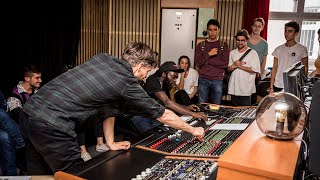
Audiovisual Arts and Media Arts
RISEBA University of Applied Sciences Riga, Latvia
Bachelor's English 3 years
EU: €4,350 Per year Non-EU: €5,500
Tap to see program details
Audiovisual Arts and Media Arts RISEBA University of Applied Sciences
This bachelor's program provides a comprehensive education in audiovisual arts and media, combining technical training, artistic development, and industry knowledge. Students explore key areas such as cinematography, directing, sound, editing, screenwriting, journalism, and immersive media. The program offers four specialization tracks: Film Producer (focusing on production management, finance, and media law), Film Director (emphasizing directing techniques and actor collaboration), Film Cinematography (covering camera work, lighting, and technology), and Audiovisual Journalism (centered on storytelling, podcasting, and investigative journalism). The curriculum includes English language study, internships, research work, and culminates with a bachelor’s thesis.
To apply for this bachelor's program, applicants must have completed recognized secondary or vocational education. Admission is competitive and based on centralized exam results in English, Mathematics, and other core subjects. If English proficiency is below B2 or not verifiable through exams or certificates (like IELTS, TOEFL, Cambridge), a university entrance test is required. All international applicants must pass a creativity entrance exam by writing an essay on one of several topics and also attend an interview with program faculty. Applicants with foreign education are exempt from centralized exams but must take the institution's admission test.
Bern University of Applied Sciences Zollikofen, Switzerland
Master's English 1,5 years
EU: €1,020 Per semester Non-EU: €1,020
Tap to see program details
Expanded Theater Bern University of Applied Sciences
This master's program focuses on the exploration of contemporary theater practices and supports students in realizing their own artistic projects. The curriculum is flexible and allows students to personalize their course selection based on their interests. Students can attend modules from various Swiss theater schools and are guided by professional theater practitioners throughout their studies. The program emphasizes interdisciplinary work, artistic research, and collaboration across institutions.
The curriculum consists of four module groups. The "Creation" module (42 ECTS) focuses on developing and presenting students' own artistic work, including the master’s thesis. "Workshops" (29 ECTS) help students enhance their performance skills and experiment with media such as space, text, sound, and body. "Theory and Management" (11 ECTS) covers theoretical, analytical, and organizational aspects of performance, while the "Encounters" module (8 ECTS) encourages networking and artistic dialogue with professionals and peers.
This master's program in performing arts is designed for applicants with a background in theater, dance, performance, or a comparable artistic field. Admission is competitive, based on an aptitude examination that evaluates the applicant’s artistic portfolio and a written project proposal. Candidates are expected to demonstrate basic skills in performance, a clear potential for developing original work, and an ability to engage in artistic reflection and transdisciplinary collaboration.
Applicants must hold a relevant bachelor's degree or provide proof of equivalent artistic experience, which will be assessed by the admission committee. A sound understanding of theater and cultural criticism is also expected. Courses are conducted in both German and English. Students must actively speak either language at a B1 level and are expected to acquire basic German (A1 level) by the second semester.
This bachelor's program prepares students to become versatile, expressive dance artists, centering on each student's role as both dancer and creator. The program focuses on personal artistic growth, helping students discover and realize their full potential by developing technical, performative, and creative abilities in tandem, with a curriculum balanced between intensity and rest to build the tools and resilience needed to create new movement and artistic contexts.
Students engage with a broad spectrum of contemporary dance styles, cultures, and physical performance, learning to create performances and shape choreography that expresses their own story, while developing and articulating their individual artistic identity through performance. The program also emphasizes using the body responsibly and maintaining its wellbeing, alongside developing the ability to collaborate with artists from other disciplines and creative backgrounds.
The program attracts international talents in contemporary dance and performance known for their versatility, educating students to become distinctive dance artists who combine technical, creative, and performative mastery to create visceral, embodied experiences within theatrical environments over the course of the four-year program.
Admission is based on a multi-round process beginning with a video assignment submitted in an initial round, the results of which determine who advances to live audition rounds held in Arnhem. Specific eligibility criteria and assessment standards for the audition were not detailed in the material provided.
Estonian Academy of Music and Theatre Tallinn, Estonia
Master's English 2 years
EU: €1,600 Per year Non-EU: €7,500
Tap to see program details
Classical Music Performance (Voice) Estonian Academy of Music and Theatre
The voice studies program offers comprehensive training in classical vocal performance, covering repertoire from the Baroque to the late Romantic eras, while also embracing contemporary vocal techniques from the 20th and 21st centuries. Students receive individual instruction, stage experience, and training in acting, stage movement, speech, and historical makeup. They also develop ensemble skills through oratorio, a cappella, and instrumental collaborations. The Opera Studio provides hands-on performance opportunities, including annual full opera productions prepared with professional directors, conductors, and designers, ensuring students are fully equipped for careers in opera and concert performance.
Applicants must hold an undergraduate diploma (or higher). Entry qualification documents must be in English and submitted with certified copies. Originals can be presented upon arrival. Proficiency in English is required. Additional program-specific requirements, such as an admission audition, apply. For detailed procedures and timelines, applicants should consult the official admission information and audition guidelines.