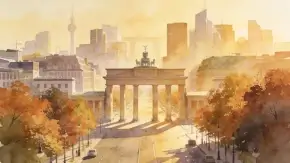

We created StudyinEurope.eu to support students like you — with clear information, personalized guidance, and a space to explore calmly. No rankings. No noise. Just tools that help — whether you're browsing on your own or getting help from Leonardo, our AI European Study Advisor.
I can help you understand and compare these programs.
Museum & Archive AccessEuropean cities hold more major art collections and archives per square kilometre than anywhere else in the world
Critical TraditionEuropean humanities programs emphasize critical theory, debate, and analytical writing at a world-class level
Unmatched Cultural DepthStudying in a continent with continuous recorded history enriches every humanities discipline in unique ways
Interdisciplinary CultureEuropean arts universities connect fine art, philosophy, history, and contemporary practice across departments
The humanities are the disciplines that ask what it means to be human — through art, literature, philosophy, and history — and Europe offers a setting for that inquiry that is genuinely hard to match. Centuries of artistic and intellectual heritage are not locked away here; they are woven into everyday life, from the museums and archives of one city to the literary and architectural landscape of the next. Studying art history, creative writing, cultural studies, or comparative literature on the continent means working close to the primary sources and the places that produced them, under faculty who sustain Europe's long tradition of critical and interpretive rigor. English-taught programs are widespread, and the field is increasingly interdisciplinary, connecting literature and art history to film studies, critical theory, museum studies, and the digital humanities. Specializations range from classical and comparative literature to creative writing and museum and curatorial practice. Far from being impractical, a humanities degree builds exactly the skills — argument, research, writing, cultural fluency, critical judgment — that careers in publishing and media, museums and cultural institutions, education, communications, the creative industries, and the nonprofit and cultural-policy sectors continue to value.
Featured Art & Humanities Programs in Europe
A selection of programs available across Europe — explore details, fees, and requirements.
Applied Creative Psychology MA
Catalyst – Institute for Creative Arts & Technology Berlin, Germany
Master's English 1 year
EU: €5,828 Per semester Non-EU: €5,828
Tap to see program details
Applied Creative Psychology MA Catalyst – Institute for Creative Arts & Technology
This master's program is one of the first in Europe dedicated to the psychology of creativity, personal development, and wellbeing, responding to a growing global demand for practitioners who can bridge artistic practice and psychological insight. Structured across three semesters and built around five core modules, the program combines scientific research with hands-on creative practice to explore how creativity intersects with human development, mental health, and social connection. In the first semester, students engage with two foundational modules: one examining how creativity evolves across different life stages through key psychological frameworks, and another exploring the therapeutic and transformative potential of expressive arts — including music, movement, visual arts, and storytelling — as tools for emotional wellbeing and personal growth. The program is designed for those who want to apply creative and psychological approaches in personal, professional, and community contexts, equipping graduates to work at the intersection of the arts, mental health, and lifelong learning. It is delivered entirely in English as a one-year, full-time course.
To apply, students must hold a bachelor's degree in a relevant discipline with a strong academic result — equivalent to an upper second-class honors degree or higher. Applicants who do not hold a formal qualification but can demonstrate relevant professional or life experience may also be considered through a non-standard admissions route. All applicants must submit personal and educational information, proof of prior education, a detailed project proposal, a sample of academic or research writing, and a portfolio. Since the program is taught in English, a minimum proficiency of IELTS 6.0 (or B2 level) is required, which can be demonstrated through a recognized language certificate or a free online test offered by the institution. Above all, applicants are expected to have a genuine passion for developing their practice at the intersection of creativity and wellbeing.
Free University of Bozen-Bolzano Bruneck-Brunico, Italy
Master's English 2 years
EU: €1,200 Per year Non-EU: €1,200
Tap to see program details
Critical Creative Practices Free University of Bozen-Bolzano
This interdisciplinary Master's program explores the intersection of design, art, culture, and technology with a critical, research-based approach. Students engage in studio work and seminars while exploring topics such as ecocriticism, spatial and material design, visual storytelling, and sustainability. Courses cover contemporary theories and practices, including environmental anthropology, gender studies, and human-computer interaction. Emphasis is placed on collaborative studio projects and dynamic workshops. Though internships are optional, students benefit from international exchange opportunities. Graduates are equipped for careers in design, art direction, multimedia, and cultural innovation.
To apply, candidates must demonstrate English proficiency at B2 level (CEFR). Admission requires a Bachelor’s degree in design, architecture, art, philosophy, or related fields, or a diploma from recognized Italian art and design academies. Alternatively, applicants with other degrees must show at least 12 ECTS in relevant areas such as design, aesthetics, or media. A commission assesses equivalency. Conditional admission is possible if the degree is pending, but it must be completed by the enrolment deadline
This interdisciplinary humanities program offers a flexible curriculum combining cultural analysis, language studies, environmental humanities, Asian studies, and more. Students can specialize in areas such as anthropology, history, literature, or media, while gaining foundational skills in critical thinking, research writing, digital literacy, and academic English. The program includes practical training, interdisciplinary projects, and a final bachelor’s exam. Elective modules allow for deep dives into specific cultural, linguistic, and societal topics. Students also develop professional communication skills and gain experience through internships.
To apply, candidates must hold a secondary school leaving certificate or equivalent qualification that grants access to higher education. Admission is based on two components: a letter of motivation and an interview. Applicants must also demonstrate English language proficiency at B2 level. For international candidates, the secondary education qualification must be recognized as equivalent.
Bern University of Applied Sciences Zollikofen, Switzerland
Master's English 2 years
EU: €1,020 Per semester Non-EU: €1,020
Tap to see program details
Contemporary Arts Practice Bern University of Applied Sciences
This master's program offers students the opportunity to specialize in one of four areas: Fine Arts, Sound Arts, Literary Writing and Literary Translation, or Performance Art. The curriculum allows for interdisciplinary exploration, and students can tailor their studies by combining modules across these areas. In the Fine Arts specialization, students work with various media and methods, including sculpture, installation, and conceptual art. The Sound Arts track focuses on experimental and electronic music, composition, and sound technology. Literary Writing and Literary Translation emphasizes writing across genres, examining literature’s relationship to other arts, and treating translation as a creative form. Performance Art explores physical and conceptual expressions through body, space, and time, integrating influences from music, literature, and visual arts.
The program encourages creative freedom, collaboration between specializations, and critical engagement with contemporary artistic discourse. It provides access to professional workshops and supports students in developing individual artistic voices in both theoretical and practical dimensions.
Admission to this master's program is selective and based on an entrance examination that evaluates your artistic aptitude and motivation. Applicants must hold a bachelor's degree in Fine Arts, Sound Arts, Literary Writing and Literary Translation, Performance Art, or a related discipline. A central requirement is the submission of a well-conceived artistic project to be developed over the two-year course of study. Candidates should demonstrate independence, creative drive, resilience, and a willingness to participate in collaborative and multidisciplinary artistic discourse.
Applicants must also show that they have the practical and theoretical skills to actively engage in the program, as well as prior experience in independently developing and presenting artistic work. Language requirements vary by specialization: while instruction is multilingual (English, German, and French), all courses in Literary Writing and Literary Translation are held in German and French. Mentoring is available in German, French, or English.